Michał Piela’s monodrama is based on Tadeusz Słobodzianek’s drama(gr. drama = czynność, akcja), nazwa używana w I połowie... More Wojtek the Bear. An Arch-Polish Story. The text was written for many voices of young soldiers and the titular bear, meaning the drama was not initially intended for a one-person performance. Its premiere, directed by Ondrej Spišák, took place on the Wola Stage of the Dramatic Theatre (May 6, 2016). Michał Piela brilliantly played the bear’s role. Now, he is dealing with this text himself.
The story presented in Słobodzianek’s drama is arch-Polish in essence. The writer, reaching for the already mythologised story of a Syrian bear taken in by soldiers of the 22nd Artillery Supply Company of the 2nd Polish Corps and their mutual connections, reveals the forgotten history of forgotten soldiers. It is a beautiful and sad story. True to how complicated Polish history was. It is conceived as a sociological cross-section of Polish society during the Second Polish Republic, and at the same time, a poetic tale. Until now, bears have not told stories. But here they are like in a children’s fairy tale.
It is not so much about cursed soldiers as about soldiers deprived of the hope of returning to their small homelands, old settlements, pushed to the margins of history due to warfare, just like their Syrian bear, whom they named Wojtek, who ended his life in exile. Although Wojtek ended up even worse off than them—he ended up in a cage in a Scottish zoo for many years. I do not even want to draw comparisons.
Słobodzianek based the play’s structure on the previously tested idea of Nasza Klasa. In that drama, subsequent lessons and comments by one of the students and songs and rhymes performed together built the story’s rhythm. Here, the storyteller is Wojtek the bear, like his soldier friends – an exile and refugee, saved/no, although defeated/no. And here too, songs, mainly soldier-related, but also sweetly idiotic, sentimental songs by Tadeusz Faliszewski, such as the famous: Happiness must be picked like fresh cherries… build a solid framework for the story.
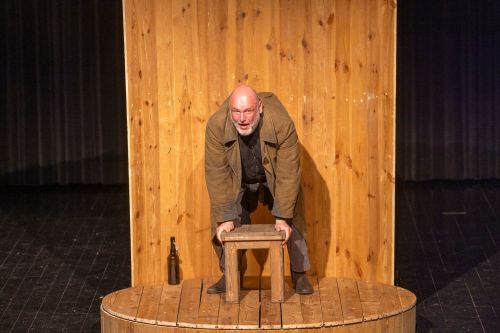
Aldona Figura reduced the stage space to a small platform in the shape of a miniature arena, a wooden circle covered at the back by a wooden wall, taking up about a third of the circle. She added a small wooden stool to this, and next to it, she designated a place on a chair for a musician, who accompanied the actor on the accordion, sometimes even turning on the alarm siren. Such a tiny stage has vast requirements, creating considerable difficulties for the performer.
From the beginning, the actor playing the bear lies in the arena, and now the audience fills the room. Now and then, he changes position. He does not look like the bear from Krupówki, with whom we posed for photos. His back is covered with a military coat, not some shaggy fur. He also does not wear an artificial bear’s muzzle. Wojciech Piela has to play bear-like.
What’s more, the bear-like quality changes as the story progresses. Right after a short introduction, introducing the story’s mood, the bear-narrator goes back to the war past, when, as a young bear, he lost his mother-bear. Then he found compassion and support among Polish soldiers. Then he grew up; his movements became heavier.
Piela found a suggestive way to present his hero without obtrusively mocking the animal. He successfully attempted to give him specific features different from human features. This is expressed in slightly slower movements, astonishing jumping ability and lightness, which for a man of such a robust build as Piela is a real sporting challenge, but also in the way of articulation, slightly disturbed by a specific flaw and the specificity of reacting to stimuli. The struggle to understand people, which Wojtek constantly fights, makes him feel closer to the audience.
Ondrej Spisak’s play featured young actors, mostly recent graduates of the Warsaw Academy. This was an important test for them. Each of them had to perform a „small monodrama”, a monologue, addressed ostensibly to Wojtek, but in reality to himself, in which they bravely tackled their own lives, their interrupted biographies, and their lost dreams. The power of these monologues lay in their simplicity, demonstrative ordinariness, and avoidance of pathos. They did not seek sympathy or revenge; they told stories. This honest tone in talking about life experiences, an escape from a settling-of-salary or accusatory tone, inspired trust.
However, in a one-person play, things are a bit different. The monologues of soldiers with different fates and entanglements are performed by the same actor – a bear for the audience. So we are dealing with a peculiar theatre within a theatre, in which the bear monologues (the bear imperceptibly becomes an actor), building a collective portrait of the generation that fought in World War II in the West, most of whom remained there forever, with a sense of an unhealed wound in their hearts. Moreover, the „bear actor” gives individual characters different features and paints their distinctiveness with a distinct line.
And the songs? In Spisak’s performance, they brought to mind the former performance by Ireneusz Kanicki and Lech Budrecki at the Classical Theatre in Warsaw (the Studio’s predecessor), Today I Can’t Come to You (1967), later performed in a dozen or so theatres throughout Poland. To this day, it is the subject of mockery as a manifestation of the Mieczysław Moczar cult, although it enjoyed incredible success. This collection of partisan songs was performed even three times a day (over 700 times in total). The performance sailed on the Batory to Canada and the USA. It was greeted enthusiastically everywhere. Of course, nostalgia caused it, longing for an irretrievably lost world.
In the monodrama of Michał Piela, who has no vocal successes behind him, the soldier songs (sometimes barracks songs) are only echoes of songs, which are not lacking in Słobodzianek’s drama. Thus, the risky association with partisan nostalgia disappears. If the bear speaks, it is already a lot; nobody expects him to sing like a frontman. Wojtek refers to musical motifs rather than polishes them, recites melodrama, hums rather than sings, and the sound is ideally given to these musical reminiscences by the virtuoso of harmony, Mateusz Wachowiak. This is enough to integrate Wojtek’s story about forgotten soldiers with an evening of suppressed patriotic sentiment, which needs some fresh air occasionally. Michał Piela’s monodrama, directed by Aldona Figura, is not so much a story about a bear who longs for and remembers old times. Still, history treats a life story rudely and has no hopes or plans for individuals. A sad, yet friendly tale. Like a dream of a better-ordered world.
Tomasz Miłkowski
BEAR WOJTEK by Tadeusz Słobodzianek, performed by Michał Piela, directed by Aldona Figura, music by Mateusz Wachowiak, impresario performance, production by Fundacja Artystyczna Acoustic, Warsaw premiere, Klub Dowództwa Garnizonu Warszawa, February 20, 2025.
[translated by Konrad Szczebiot]