About wine and a coat
At the post-premiere reception at the „Polish Theatre in the Underground”, on March 21, 2025, in Wrocław, a tasting aura appeared as if by itself, preceded by a subtle, slightly restrained viewing, near the catering delicacies. After a dozen or so minutes, Michał Opaliński, a Underground Theatre Council member who performed in „Hexes”, took the floor.
He gratefully and warmly thanked, standing next to him, Monika Pęcikiewicz, the director of the underground bakery’s latest stage production, for her latest contribution to the artistic achievements of the Wrocław theatre. He also introduced many of the creators of the completed performance, including the author of the famous novel entitled „Heksy” – Agnieszka Szpila and Anna Kłos, who, together with the writer, prepared the dramaturgy and stage adaptation of her book. He also welcomed the smiling actresses. He did not forget about the actors. He also distinguished other important co-creators of the finished premiere. He bowed low and festively to the entire theatre crew and the guests. Michał Opaliński’s statement was charming, courteous, and saturated with stage shine. It was an autotelic, improvised value, available only once. Katarzyna Majewska, also a member of this Council, added a few sentences. The speech of its third, solid pillar and at the same time, which is worth emphasising, the curator of the theatre project (undertaking) being assessed, i.e. Piotr Rudzki, was missing. Unyielding duties probably meant that immediately after the final applause of the performance, he left, or „marched off – left, right into the blue distance”.
Despite the late hour, most people were having a great time. I noticed no signs of fatigue, even in my own place. There was a friendly, carefree mood. An important, but not the only, reason was—like in Cana of Galilee—a surprising abundance of good wine, especially dry red wine.
Previously—probably worse—it was over after half an hour. In connection with this, the regulars of underground premieres quickly left the audience. After the first glass, they would playfully and hastily seek the next ones.
Post-performance, lively and engaging discussions took centre stage, uniting the interlocutors in a shared appreciation for the art. The good-natured party continued, much to the satisfaction of the hosts and other relaxed theatre lovers, celebrating this more or less abundant and necessary form from the point of view of ancient theatre cult, always festive bacchanalia, preserved for centuries.
This time too, the wine was in the dirt, and there were still countless unopened bottles. This miraculous abundance could have been influenced by the occasional 30-zloty tariff collected from invited guests. They also saved on glass wine glasses. They were replaced with tasteful, tasteful in every respect, reusable cardboard cups. They do not break and, together with the wine, affect better, in a friendly way, other cups essential for tasting, taste buds, and the entire theatrical, i.e., Dionysian palate. They refine the colour of the wine immensely, enrich its exquisite taste and intensify the bouquet (of scent) accompanying it. It is known from the ancient Greek Dionysia that wine served in this way tastes better and more profound. It is a pity that there was no wine in cartons. Despite this, underground bottled wine is dreamed of at night, effusively and dryly.
Around half past one (after midnight), I got ready to go to a nearby hotel. My coat was hung involuntarily, as one of the first to be hung on a long metal hanger, deeply, abundantly and distinctly covered from above, hidden by the outer garments of other spectators. It was challenging and complicated to access. I know because I “ran through” it thoroughly once, twice and three times: from top to bottom, massively and layered, exquisite, elegant – worthy of imitation or popularisation – the hanger. And here’s a fig with poppy seeds – and what a fig… I was worried because my tastefully tailored and thin, but warm, dark navy, soft and delicate sheep’s wool coat had disappeared. I was immediately seized by ominous shivers and Leninist „What to do?”.
I crossed myself providentially and said goodbye to this and that. I went out in a short, airy jacket outside the theatre and on the way to the hotel, I came across the cold and, by chance, a small group of people dressed warmer than I was. And among them, I noticed two: connected with the Bakery, experienced, distinguished underground actresses. One of them, reliable, exquisite and fascinating, with whom (infatuated) I had previously talked for a dozen or so minutes (and with the other – her second – also, but a few), was wearing – surprisingly! – My graceful, elegant coat. She looked phenomenal and attractive in it. It fit perfectly. Nevertheless, she handed it to me (after making sure it was mine) with a delicious, tempting smile, to emphasise her subtle, fully committed hospitality.
A spectacle to behold
Without this, the reviewer’s pen does not move.
Because
without seeing
Nothing from judging.
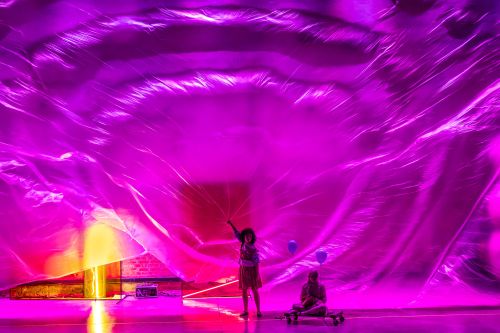
The premiere was a fascinating, innovative spectacle. The huge, extensive base of the three-dimensional, large-in-size, excessively expansive stage was the overly exposed half of the floor of the large hall, with a high ceiling, situated opposite the audience’s multi-level chairs, similar to the one in Warsaw’s slightly older but still „New Theatre.”
It was going to be a long presentation.
I was afraid that the extensive stage’s scenographic development would have problems. Due to its overly versatile and not very compatible volume, it would be plagued with many deep and static voids during the three-hour performance.
The scenography was designed brilliantly, functionally and originally. It was mobile, i.e. changeable: carried, moved, moved… It cooperated with sometimes innovative lighting effects. There was plenty of it everywhere. It was accompanied by well-developed, inventive, as if ubiquitous, multi-plane and creatively diverse stage movement (sometimes dance), complemented by dynamic music and other sounds. Something was always happening. This probably required an abundance of patient and honest stage rehearsals. The costumes were impressive in their inventiveness, aesthetic taste, and intriguing scarcity. There was a lot of skillfully incorporated – actual and simulated – but not very sensual and attractive, as if taken from life, helpless nudity.
Forte and piano
The performance undoubtedly had a specific resonance, referring in particular to the piano. Not so much to the wooden casing, keys, or pedals, but to its specific possible volume of more or less dynamic (as loud as muted) amplified by microphones, often indistinct dialogues and monologues, and other musical and extra-musical sounds. During the premiere, forceful statements, with an excessively high tone, were predominant – loud, sometimes shouted. They exposed emotions more than content. They escaped attention – cognitively crucial: neurotic, heuristic, hermeneutically founded, more or less covered – the essence and meaning of not only short lines, monologues or dialogues, but especially – as a consequence – larger fragments of the stage, both verbal and overall (cultural, aesthetic, artistic) resonance, i.e. the message of important for the stage managers and the audience – diverse and specific – multi-aspect values.
This was “facilitated” by the not very well-developed, in terms of technology and functionality, sound system, bad acoustics, and not adapted to the needs of the theatre. In this case, the leading cause and obstacle was the architecturally simplified, factory-like, bakery destination of the building, which made it difficult to receive not only loud statements. But also, the quiet lines were not sufficiently resonant because of it – they did not resonate clearly enough, the purity of sound and clarity disappeared, similarly to Krystian Lupa’s play, entitled „Balconies. Love Songs” (Polish Theatre in the Underground, premiere on February 10, 2024).
I will again emphasise the negative overtones of the verbal overexpression in the play. At first, it surprised me. Later, it stopped having a stimulating effect. It’s too frequent that loud stimuli overlap, discouraging and tiresome. Also, for this reason, the final reaction of the audience and artists, as well as numerous supporters and friends who were favourable to this theatre, was calm and balanced. There was no ovation, short and too subdued, for this event, applause.
Jerzy Kosiewicz
Creators:
directed by Monika Pęcikiewicz
dramaturgy and adaptation (using fragments of improvisations by Agnieszka Szpila and Anna Kłos), Agnieszka Szpila
set design and costumes Grzegorz Więckowski, Karolina Benoit
video Sebastian Pańczyk
music Stefan Węgłowski
stage movement and choreography Bartłomiej Gąsior, Aleksandra Grącka-Baczyńska
lighting direction Wojciech Puś
assistant director Michał Opaliński
Cast:
Anna Ilczuk – Szajbel / Mathilde
Justyna Janowska – Helene / Ludwige
Andrzej Kłak – Bartek /Anti-terrorist / Brother Gladiolus / Straszydlak
Anastazja Kowalska – Pamela Fellatio / Kunegunde
Michał Mrozek – Brodatka / Panda Neighbor / Brother Immaculate / Mathias
Piotr Nerlewski – Rair / Babel
Michał Opaliński – Rozchodnik (Father Szajbel) / Plotek / Brother Hubert
Janka Woźnicka – Trytoma/Matka Szajbel / Activistic Mother / Gretchen
Katarzyna Wuczko – Starodziewica / Ursule / Bernadette/Bokashi
project curator Piotr Rudzki
production Renata Majewska
poster, photos Natalia Kabanow
internet Piotr Sarama
promotion, marketing Mariusz Turchan, Paulina Tomczyk
subtitles Alicja Szumańska
Coordination of artistic work, Ada Tabisz
technical director Piotr Jacyk
Premiere: March 21, 2025, at the Grotowski Institute’s Centre for the Performing Arts (Żywa Kultura Bakery), ul. Ks. Witolda 62, Wrocław
Co-production of the Grotowski Institute Jerzy Grotowski in Wrocław and the Polish Theatre Foundation — TP for Art.